MG Expands Electric Portfolio with the MG4 EV Urban and the S9 PHEV Seven-Seater SUV Targeting European Market Accessibility

Since its re-entry into the European market under the stewardship of SAIC Motor, MG has consistently disrupted the automotive landscape by offering sophisticated electric vehicles at highly competitive price points. The MG4, in particular, has established itself as a formidable contender in the fleet and corporate sectors, balancing performance with cost-efficiency. Recognizing the shifting demands of both private buyers and urban fleet operators, the Chinese-British manufacturer is now expanding its lineup with the introduction of the MG4 EV Urban. While the name suggests a vehicle optimized for city centers and metropolitan navigation, a comprehensive test drive through the varied terrain surrounding Namur, Belgium, reveals a vehicle with capabilities that extend far beyond the city limits.

As the electric vehicle (EV) market matures, the industry’s focus is pivoting from early adopters toward the broader, more price-sensitive "mass market." MG is positioning the MG4 EV Urban as a strategic asset in this transition. Although it shares a nameplate with the standard MG4—which is currently undergoing a mid-cycle facelift—the Urban variant is built upon a distinct engineering philosophy designed to maximize accessibility without compromising the core tenets of the electric driving experience.
Engineering Foundations: The E3 Platform and Powertrain Dynamics
The MG4 EV Urban is built upon the newly developed E3 platform, a modular architecture engineered to optimize compactness, energy efficiency, and overall vehicle weight distribution. This platform represents a significant departure from the standard MG4’s rear-wheel-drive (RWD) layout. The Urban variant utilizes a front-wheel-drive (FWD) configuration with a front-mounted motor. This shift is intended to provide a more traditional and "reassuring" driving sensation for motorists transitioning from internal combustion engine (ICE) vehicles, while also simplifying the drivetrain for cost-effectiveness.

The vehicle is offered in two primary trim levels: Comfort and Premium. To cater to different range requirements, MG provides two battery capacities. The entry-level 43 kWh battery offers a WLTP-rated range of 325 kilometers, while the larger 54 kWh battery provides a range of 405 to 416 kilometers, depending on the specific configuration. The motors produce either 149 hp (110 kW) or 160 hp (118 kW), outputs that are more than sufficient for the vehicle’s intended urban and suburban use cases.
One of the standout features of the E3 platform is its DC fast-charging capability. Despite its positioning as a budget-friendly model, the MG4 EV Urban supports charging speeds of up to 150 kW. This allows the 43 kWh battery to charge from 10% to 80% in approximately 28 minutes, while the 54 kWh unit requires only 30 minutes for the same increment. This high-speed charging infrastructure ensures that the vehicle remains viable for occasional long-distance travel, mitigating the "range anxiety" often associated with smaller-battery EVs.

Aesthetic Evolution: A "Vibe" of the Cyberster
Visually, the MG4 EV Urban carves out its own identity within the MG family. The original MG4 was characterized by a bold, angular, and somewhat aggressive design language that appealed to a younger, tech-focused demographic. In contrast, the Urban variant adopts a more fluid and understated silhouette. The lines are softer, and the overall aesthetic is more "European," designed to blend seamlessly into modern cityscapes.
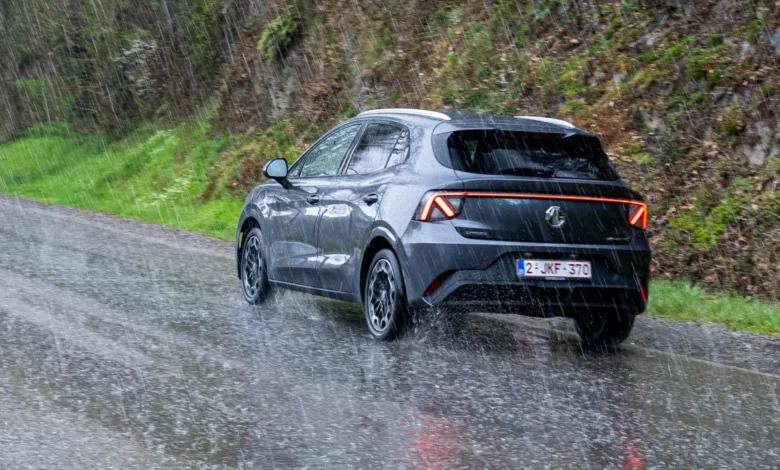
Design cues from MG’s high-profile Cyberster electric roadster are evident, particularly at the rear. The taillight assembly and the subtle integrated spoiler reflect a premium design influence, elevating the car’s perceived value. This "softer" approach to design is a calculated move to appeal to a broader audience, including corporate fleets looking for professional yet modern vehicles and private families seeking a practical daily driver.

Interior Pragmatism and Technological Integration
Inside, the MG4 EV Urban prioritizes functionality and durability, adhering to a pragmatic philosophy that aligns with European consumer expectations. The cabin is well-finished, utilizing materials that feel robust, though the color palette remains predominantly dark. While the long-term wear-and-tear of these materials remains to be seen, the initial impression is one of quality and solid construction.
Technology is centered around two primary displays: a 12.8-inch central infotainment touchscreen and a 7-inch digital instrument cluster for the driver. The infotainment system is designed to be intuitive, housing the majority of the vehicle’s controls to maintain a clean, uncluttered dashboard.

Space management is another area where the MG4 EV Urban punches above its weight class. Despite its compact exterior length of 4.40 meters and a wheelbase of 2.13 meters, the vehicle offers a generous 577 liters of cargo space. When the rear seats are folded down, this capacity expands to a substantial 1,364 liters. This makes the Urban variant one of the most practical vehicles in its segment, capable of handling everything from grocery runs to bulky sports equipment or business supplies.
Performance Analysis: Precision and Efficiency
During the test drive in Namur, the MG4 EV Urban demonstrated a surprising level of agility. The steering is calibrated to be slightly firmer than expected for a city car, providing a sense of precision that allows the driver to navigate narrow streets and heavy traffic with confidence. This "point-and-shoot" handling makes it an ideal tool for the urban environment, yet it maintains enough stability and poise to feel secure at highway speeds.

The vehicle’s efficiency was a highlight of the testing phase. Over a mixed route consisting of city stop-and-go traffic, winding rural roads, and highway stretches, the MG4 EV Urban returned an average consumption of 15.6 kWh/100km. This figure suggests that MG’s focus on energy management and the aerodynamic profile of the E3 platform are paying dividends in real-world scenarios.
One area identified for potential improvement is sound insulation. While the electric powertrain is inherently quiet, wind and road noise become more perceptible when driving on uneven surfaces or at higher speeds. However, given the vehicle’s price point, this is a common trade-off in the segment and does not significantly detract from the overall driving experience.

Market Positioning and Economic Impact
The MG4 EV Urban is priced to be a market disruptor. The entry-level 43 kWh model starts at €26,990 (including VAT), while the 54 kWh versions are priced between €30,990 and €32,990. For the fleet and professional market, MG has introduced aggressive financial leasing options starting at €299 per month. This pricing strategy places the MG4 EV Urban in direct competition with smaller B-segment EVs and even some well-equipped internal combustion hatchbacks.
A significant technological milestone mentioned by MG is the upcoming introduction of "semi-solid-state" battery technology by the end of the year. This would make MG one of the first manufacturers to bring this advanced chemistry to the mass market. Semi-solid-state batteries promise higher energy density, improved safety, and faster charging compared to traditional liquid-electrolyte lithium-ion batteries, potentially giving the MG4 a significant competitive advantage in the near future.

The MG S9 PHEV: A New Flagship for the Family Segment
While the MG4 EV Urban targets the compact segment, MG also utilized the event to showcase the new MG S9 PHEV. This model serves as the brand’s flagship seven-seater SUV, utilizing plug-in hybrid technology to bridge the gap for families not yet ready for full electrification.
Measuring nearly 5 meters in length, the S9 is a commanding presence on the road. It is powered by a 1.5-liter turbocharged gasoline engine paired with a 24.7 kWh battery, delivering an impressive electric-only range of up to 100 kilometers. This range is particularly significant for tax purposes in many European markets, where 100km is often the threshold for maximum fiscal incentives.

The interior of the S9 reflects its flagship status, featuring dual 12.3-inch screens and a high level of standard equipment. While its sheer size limits its "dynamic" potential compared to the more nimble MG4, it offers a refined and spacious environment for large families. The S9 represents MG’s ambition to compete in the premium SUV segment, offering a value proposition that challenges established European and Japanese rivals.
Conclusion and Broader Implications
The expansion of MG’s lineup with the MG4 EV Urban and the S9 PHEV signals a new phase in the brand’s European growth strategy. By diversifying its offerings to include a budget-friendly urban specialist and a high-capacity family flagship, MG is effectively covering the most critical segments of the current market.

The MG4 EV Urban, in particular, proves that "affordable" does not have to mean "compromised." With its efficient E3 platform, rapid charging capabilities, and practical interior, it is well-positioned to become a staple of both private driveways and corporate fleets. As the industry watches for the arrival of semi-solid-state battery technology later this year, MG is no longer just a budget alternative; it is increasingly becoming a technological pacesetter in the global shift toward sustainable mobility.
Related posts: