Navigating the Evolution of the Belgian Driving License A Comprehensive Guide to Modern Regulations and Regional Divergence

The landscape of Belgian road safety and driver licensing has undergone a seismic shift over the last decade, transitioning from a unified federal system to a decentralized model governed by regional authorities. This evolution, spurred by the Sixth State Reform, has resulted in a complex tapestry of regulations that vary significantly between Flanders, Wallonia, and the Brussels-Capital Region. For prospective drivers and long-term license holders alike, understanding these nuances is no longer a matter of administrative curiosity but a legal necessity. As Belgium moves toward a more digitized and stringent framework, the procedures for obtaining and maintaining a Category B license—the standard permit for passenger cars—have become more rigorous, emphasizing medical transparency, modern testing methods, and updated documentation.
The Regionalization of Competencies and Jurisdictional Rules
One of the most critical developments in recent years is the regionalization of the driving exam process. While the core traffic laws remain largely federal, the "way" one earns a license is now determined by the region in which the candidate resides or chooses to train. A fundamental rule that has emerged from this decentralization is the prohibition of "jurisdiction hopping." Candidates are strictly forbidden from taking their theoretical exam in one region (for example, the Brussels-Capital Region) and their practical exam in another (such as Leuven in Flanders). This rule ensures that candidates are tested according to the specific educational tracks and evaluation criteria set by the regional government overseeing their training.
Furthermore, the type of vehicle used during the examination carries significant legal weight. Under current Belgian law, if a candidate successfully completes their practical exam using a vehicle with an automatic transmission, their license will be restricted to automatic vehicles only. To remove this restriction and drive a manual transmission vehicle, the holder must undergo a separate practical test. This distinction reflects a broader European trend toward recognizing the mechanical differences in vehicle operation as EVs and hybrids become more prevalent.
Medical Integrity and the Declaration of Honor
A cornerstone of the modern Belgian licensing system is the emphasis on physical and mental fitness. It is legally prohibited to attempt a driving exam if one’s health condition is incompatible with the safe operation of a motor vehicle. To streamline this, the government has introduced a "declaration on honor" (verklaring op erewoord). When applying for a provisional license, every candidate must sign this document, self-certifying that they do not suffer from medical conditions that could impair their driving.
This is not merely a formality. Fraudulent declarations carry severe consequences, ranging from heavy financial penalties to imprisonment. For individuals with known disabilities or health issues—such as epilepsy, severe diabetes, or vision impairments—the path to a license involves the Center for Driving Ability and Vehicle Adaptation (CARA), a division of the VIAS Institute. CARA specialists evaluate whether a driver requires vehicle modifications or specific restrictions to operate a car safely. This medical oversight ensures that while the road remains accessible to many, safety is never compromised for the sake of convenience.
The Theoretical Gateway: Standards and Infractions
The journey to a full license begins at the age of 17 with the theoretical exam. While the minimum age is standardized, the examination itself has become more difficult. To pass, a candidate must score at least 41 out of 50 points. However, the scoring system is weighted to penalize dangerous gaps in knowledge. While a standard incorrect answer results in the loss of one point, a "grave error" (zware fout) results in a five-point deduction. Consequently, two grave errors lead to an automatic failure, even if every other question is answered correctly.
Grave errors are specifically defined as infractions of the third or fourth degree, such as ignoring a red light, driving the wrong way on a one-way street, or exceeding the speed limit. This weighting system is designed to ensure that no driver takes to the road without a fundamental understanding of the most life-threatening traffic violations. Additionally, exams must be conducted in the official language of the region, though translation services are often available for a fee in specific centers to accommodate Belgium’s international population.
Educational Pathways: The Cost of Experience
Candidates in Belgium generally choose between two primary paths: professional instruction via a driving school or self-study with a private guide. Professional schooling is the most efficient but also the most expensive route, with comprehensive packages often reaching or exceeding €2,000. These schools provide the advantage of dual-control vehicles and instructors trained to identify subtle technical errors.
Conversely, the "free path" (vrije begeleiding) allows candidates to learn from a family member or friend. While more affordable, this method places a heavy burden of responsibility on the guide, who must have held a valid Belgian or European license for at least eight years and must not have been stripped of their right to drive within the last three years. In recent years, the administration has modernized the application process for those choosing to drive without a guide (after 20 hours of professional school). Since October 2022, the "Beldrive" application has allowed for the online request of provisional licenses, reducing the bureaucratic burden on municipal offices.
The "Three-Year Rule" and the Impending Royal Decree
A significant point of friction in the current system is the expiration of provisional licenses. Historically, if a candidate’s provisional license expired before they passed their practical exam, they were subject to a three-year "waiting period" during which they could not apply for a new provisional permit.
However, legislative changes are currently in motion via a new Royal Decree. Under the proposed (and partially implemented) updates, the strict three-year ban may be bypassed by following a specific remedial track. If a license expires, the candidate may be required to complete six hours of mandatory driving school instruction. This allows for a one-time extension of the provisional license for an additional year. If the candidate fails to pass the exam within this extension period, the three-year waiting period then applies. This shift represents a move toward "rehabilitative" education rather than purely punitive administrative delays.
The Risk Perception Test and Regional Requirements
Before a candidate can even book a practical exam, they must pass the Risk Perception Test (RPT). This computer-based assessment uses video clips to evaluate a driver’s ability to identify potential hazards on the road in real-time. It is a mandatory hurdle in both Flanders and Brussels, though the specific implementation varies.
In the Brussels-Capital Region, an additional layer of social responsibility was added on November 1, 2018: mandatory first aid training. Organized in partnership with the Red Cross, this requirement includes an individual theoretical module followed by a three-hour practical session. The goal is to ensure that every new driver is equipped with the basic life-saving skills necessary to assist at the scene of a traffic accident before emergency services arrive.
The Practical Examination and the Probationary Year
The practical exam is the final barrier, accessible only to those who are at least 18 years old and have completed the mandatory training period (ranging from 3 to 36 months depending on the provisional license type). The exam is rigorous; failing twice consecutively triggers a mandatory requirement of six hours of professional driving school instruction before a third attempt is permitted.
Once the exam is passed, the driver enters what is effectively a "probationary year." During this first year of full licensure, the legal system is significantly less tolerant of infractions. Any "grave" violation during this period can lead to a swifter suspension of driving privileges compared to a veteran driver. This policy is backed by data from the VIAS Institute, which consistently shows that novice drivers are at a higher risk of being involved in serious accidents during their first 12 months of independent driving.
The Phase-out of the "Pink Paper" License
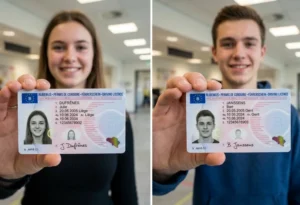
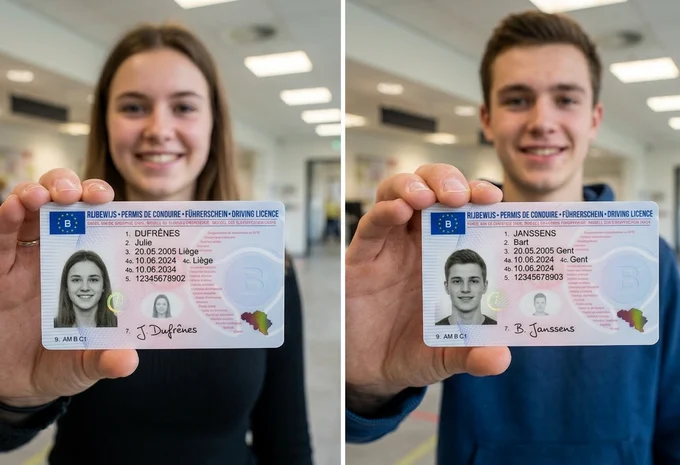
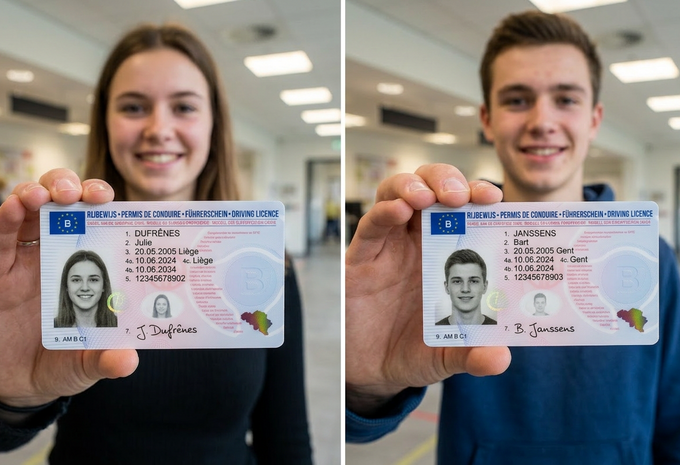
For those who already hold a license, a significant administrative deadline is approaching. The traditional pink paper licenses, which many Belgians have held for decades, were originally issued without an expiration date. However, European Union Directive 2006/126/EC mandates that all member states transition to a standardized, credit-card-style plastic license by 2033.
The plastic licenses have a 10-year administrative validity, primarily to ensure that the photograph remains a current likeness of the holder. While the paper licenses remain legally valid within Belgium until the 2033 deadline, they are increasingly problematic for international travel. Rental car agencies in non-EU countries often refuse the paper version if the photo is outdated or the document is damaged. Authorities recommend that any driver with a license issued before 1989—or one where the photo is no longer recognizable—proactively exchange it at their local town hall for a fee of approximately €20 to €35.
The Future of the Point System in Belgium
While many neighboring countries like France and Germany utilize a "points-based" license system—where infractions result in the loss of points and eventual revocation of the license—Belgium remains an outlier. Although the legal framework for a points system has been ready for years, it has not yet been implemented due to a lack of executive decrees and political consensus. As of 2024, the "points license" remains a theoretical concept, though road safety advocates continue to push for its activation as a tool to curb recidivism among dangerous drivers.
In conclusion, the Belgian driving license has evolved from a simple permit into a sophisticated regulatory tool. Whether it is the digital integration of the Beldrive app, the regionalized first aid requirements in Brussels, or the strict medical declarations, the system is designed with a singular focus: reducing road fatalities toward the "Vision Zero" goal. For the modern driver, staying informed about these changing regulations is the only way to ensure continued mobility and legal compliance on Belgium’s increasingly complex road network.
Related posts: