Everything You Need to Know About the Belgian Driving License in 2026 A Comprehensive Guide to Regional Rules and Digital Transitions

The landscape of obtaining and maintaining a driving license in Belgium has undergone a profound transformation as of 2026, driven by the final implementation phases of the 6th State Reform and a nationwide push toward digitalization. While the core legal framework remains rooted in the Royal Decree of March 23, 1998, the practical reality for Belgian motorists is now defined by significant regional variations. Flanders, Wallonia, and the Brussels-Capital Region have each exercised their devolved powers to create distinct pathways for new drivers, while federal authorities have accelerated the transition toward a fully digital administrative ecosystem. For the millions of existing license holders, the next several years represent a critical window for administrative compliance, particularly as the deadline for phasing out legacy paper documents approaches.
The Regionalization of Driver Training and Examination
Since the regionalization of training and examination competencies, the path to a Category B license (passenger car) is no longer uniform across the Belgian territory. A pivotal regulation solidified in 2026 strictly prohibits "license tourism" between regions. Candidates are now legally bound to complete their entire training and examination cycle within the region where they initiated their process. For instance, a student who passes their theoretical exam in Brussels is no longer permitted to take their practical exam in a Walloon center like Louvain-la-Neuve. This change was enacted to ensure that learners are tested on the specific road environments and regulatory nuances of the region where they received their initial instruction.
The regional governments justify this divergence as a method to tailor road safety to local needs. Flanders has focused heavily on post-license monitoring, Wallonia on documented experience through mandatory roadbooks, and Brussels on emergency preparedness through mandatory first aid training.
The Theoretical Foundation: National Standards with Regional Pricing
Despite regional differences in administration, the standards for the theoretical exam remain largely harmonized to ensure a baseline of safety across the country. Candidates must be at least 17 years old to sit for the exam. The test consists of 50 questions, with a passing grade set at 41/50. However, the scoring system is weighted heavily against safety violations; a "serious offense"—such as running a red light or exceeding the speed limit in a school zone—results in a 5-point deduction. Committing two serious offenses results in an immediate failure, regardless of other correct answers.
In 2026, the costs for the theoretical exam are subject to annual indexation and currently stand at:
- Wallonia: €17
- Brussels: €19
- Flanders: €19
Language accessibility remains a cornerstone of the system. While exams are conducted in the official language of the region, the German-speaking community retains the right to test in German. For other languages, candidates can request a sworn interpreter for an additional fee, typically ranging between €50 and €60.
The Learning Phase: From Provisional Licenses to Roadbooks
The transition from theory to practice is managed through three distinct models of provisional licenses, often referred to as "learning licenses."
- Model 36 (M36): This is the traditional "free track" model. It allows for 36 months of validity and requires the candidate to be accompanied by a guide. In 2026, the requirements for guides have tightened. A guide must have held a Belgian or EU driving license for at least eight years and must not have been disqualified from driving within the last three years. In Flanders and Wallonia, guides are now required to undergo a brief training session or pass a basic knowledge test before they can be officially registered.
- Model 18 (M18): Designed for those who wish to drive alone, this model requires the completion of at least 20 hours of professional instruction at an accredited driving school. After receiving a certificate of aptitude, the learner can drive solo for up to 18 months.
- Model 12 (M12): This is a transitional license for those whose M36 or M18 has expired. It allows a further 12 months of training under specific conditions, avoiding the three-year waiting period previously imposed on those who failed to pass their exam within the initial window.
A significant administrative evolution in 2026 is the BelDrive platform. This digital portal allows candidates to apply for their provisional licenses and their final definitive licenses entirely online, linking examination centers directly with municipal administrations. This has reduced the average wait time for document processing from weeks to mere days.
Mandatory Experience: The Roadbook and Risk Perception
In Wallonia and Brussels, the 2026 regulations place a heavy emphasis on verified experience. Candidates opting for the free track must maintain a "roadbook," documenting at least 1,500 kilometers of supervised driving before they are eligible for the practical exam. This measure was introduced following data suggesting that learners who logged more miles were 30% less likely to be involved in accidents during their first year of solo driving.
Furthermore, all candidates nationwide must pass a Risk Perception Test on a computer before taking the practical exam. This test evaluates the driver’s ability to identify potential hazards in real-time video scenarios. In Brussels, this is supplemented by a mandatory, free first aid course provided by the Red Cross, ensuring that every new driver in the capital is equipped to provide life-saving assistance at an accident scene.
The Practical Exam and the "Flemish Exception"
The practical examination can be taken from the age of 18, provided the mandatory minimum training period (usually three to nine months, depending on the region) has been met. The costs for the practical exam in 2026 are approximately €42 in Wallonia, €46 in Brussels, and €51 in Flanders.
A major point of distinction in 2026 remains the Flemish "Return Moment" (Terugkommoment). Any driver who was domiciled in Flanders at the time their definitive license was issued must attend a four-hour practical session between the sixth and ninth month of their driving career. This session, which costs €122, focuses on emergency maneuvers and eco-driving. Failure to attend this session is treated as a serious legal infraction, with potential fines reaching up to €4,000. This policy has faced criticism for being a "hidden tax," but the Flemish government maintains that it has significantly lowered the accident rate among the 18-24 age demographic.
Digitalization and the 2033 Deadline
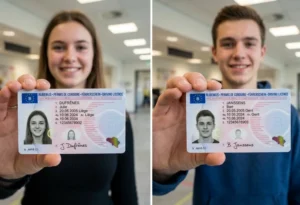
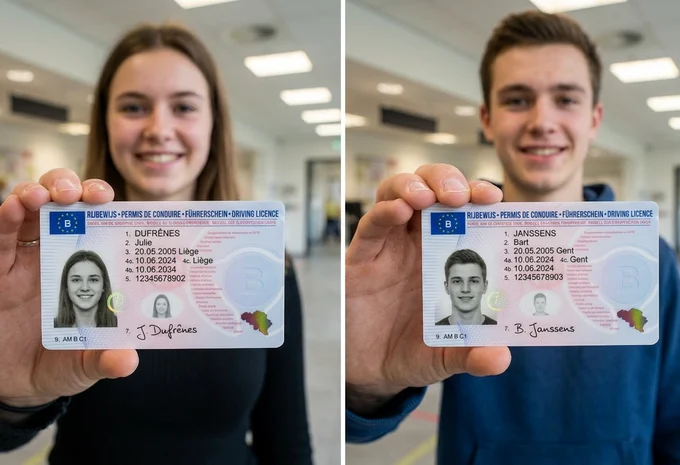
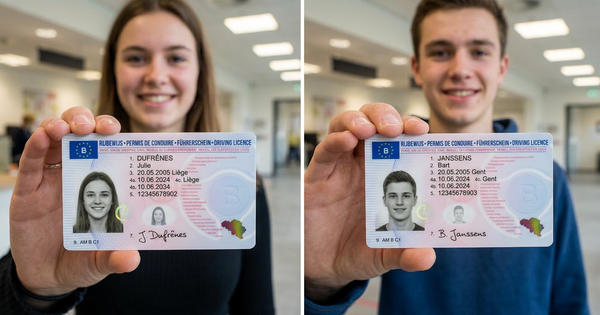
Belgium is currently in the midst of a massive administrative migration. Following EU Directive 2006/126/EC, all traditional paper driving licenses (the famous "pink folders") must be replaced by the bank-card format by 2033. However, authorities are urging citizens to make the switch sooner. The older paper documents often lack modern security features and are increasingly rejected by car rental agencies abroad.
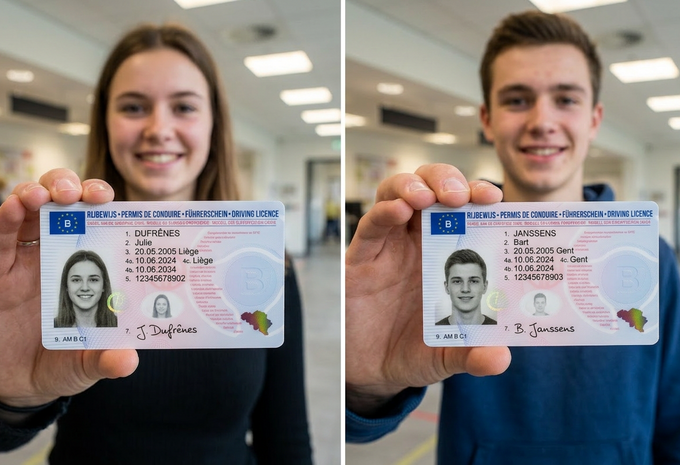
The most significant technological leap in 2026 is the integration of the driving license into the MyGov.be digital wallet. Belgian residents can now present a digital version of their license during police checks within the national territory. While this digital version is legally equivalent to the physical card in Belgium, it is not yet recognized for international travel or in all EU member states, meaning drivers must still carry their physical card when crossing borders.
License Categories and Modern Exemptions
The 2026 regulations also reflect changes in vehicle technology and logistics.
- Category B (Car): Limited to vehicles with a Maximum Authorized Mass (MAM) of 3,500 kg.
- Electric Vehicle Exemption: To encourage the decarbonization of logistics, a special derogation allows holders of a Category B license to drive electric vans weighing up to 4,250 kg. This accounts for the additional weight of battery packs without requiring a heavy goods vehicle (C1) license.
- Motorcycles: Holders of a Category B license issued after May 2011 can drive 125cc motorcycles (max 11kW) within Belgium after completing four hours of training, provided they have held their license for at least two years.
Enforcement, Penalties, and License Recovery
The Belgian judicial system has become increasingly stringent regarding road safety. While the "points-based license" system has been legislatively approved, its full execution remains a subject of ongoing political debate in 2026. However, judges have expanded the use of "reintegration exams."
Drivers who have their license revoked for serious offenses—such as driving under the influence or excessive speeding—must now frequently pass four specific tests to regain their right to drive: medical, psychological, theoretical, and practical. The cost of these reintegration procedures can easily exceed €1,000, acting as a significant financial deterrent.
In the event of loss or theft, the BelDrive system has simplified the replacement process. A declaration of loss can be made online, and a duplicate is issued for a fee of approximately €25. However, for those traveling abroad, the Belgian Ministry of Foreign Affairs warns that embassies and consulates cannot issue replacement licenses. Travelers are advised to obtain an International Driving Permit (IDP) from their local municipality before leaving Europe, a document that remains valid for three years and is recognized in over 150 countries.
Conclusion and Analysis
The 2026 state of the Belgian driving license reflects a country balancing regional autonomy with European integration. The system has become more expensive and administratively complex due to regionalization, yet more accessible through digitalization. The shift toward the "Return Moment" in Flanders and the "Roadbook" in Wallonia signals a move away from "one-and-done" testing toward a philosophy of continuous learning and verified experience.
For the individual, the message is clear: the driving license is no longer a static document but a dynamic credential that requires administrative attention. Whether it is the 10-year renewal cycle of the bank-card format, the mandatory Flemish training sessions, or the looming 2033 deadline for paper licenses, staying legally mobile in Belgium now requires a proactive approach to both regional laws and digital tools. As the MyGov.be platform matures, the eventual goal is a seamless, paperless experience, but for the transition period of the mid-2020s, vigilance remains the driver’s best companion.
Related posts: