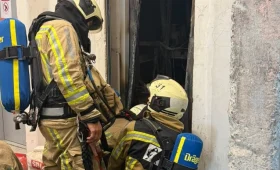
Approximately 100 individuals gathered in a somber memorial service outside the Oxy Tower building in central Brussels, a site still bearing the scars of a devastating fire that claimed six lives last week. The ceremony, organized by trade unions, served as a poignant tribute to the victims and a stark reminder of the inherent dangers within the construction sector. The tragedy has ignited a crucial conversation about workplace safety, regulatory oversight, and the pressures faced by workers in high-risk environments.
The Tragedy Unfolds
The fatal inferno erupted last Tuesday at the Oxy Tower construction site, a project employing an estimated 250 workers. The fire, the cause of which remains under active investigation, tragically resulted in the deaths of six individuals. Their bodies were discovered in one of the building’s lift shafts, a discovery that has deeply shaken the community. In addition to the fatalities, two other workers sustained severe injuries and are currently in critical condition, their families anxiously awaiting updates.
The building itself, formerly the administrative headquarters of the City of Brussels, was undergoing extensive renovation with plans to transform it into a mixed-use complex featuring residential flats, restaurants, and a rooftop bar. The fire brought these ambitious plans to a halt, casting a shadow over the future of the project and the livelihoods of those involved.
A Chronology of Events and Investigation
The incident has initiated a rigorous investigation by the relevant authorities. While the initial phase of the investigation has concluded, allowing workers to return to the site for the first time since the tragedy, the precise sequence of events and the definitive cause of the fire are yet to be officially determined. Belgian law mandates thorough investigations into workplace fatalities, with potential implications for the companies involved and regulatory bodies responsible for site oversight.
- Last Tuesday: A devastating fire breaks out at the Oxy Tower construction site, resulting in six fatalities and two serious injuries.
- Following Days: Emergency services work to secure the site and recover the victims. Investigations commence to determine the cause of the fire.
- Formal Identification: The bodies of the six victims are formally identified.
- Memorial Service: Trade unions organize a memorial service outside the Oxy Tower, attended by approximately 100 people, including workers, union representatives, and officials.
- Site Reopening: Following the completion of the initial investigation, workers are permitted to return to the construction site.
- Ongoing Investigation: Authorities continue to investigate the cause of the fire and the circumstances surrounding the fatalities.
Voices of Grief and Concern
The memorial service was marked by a profound sense of grief and a unified call for enhanced safety measures. Union representatives laid wreaths at the building’s gates, their actions a silent testament to the loss experienced. Speeches delivered by prominent union leaders underscored the urgent need to prioritize worker safety.
Marie-Hélène Ska, General Secretary of the CSC union, and Bert Engelaar, President of the FGTB union, addressed the gathering, their words echoing the collective sorrow and determination to prevent future tragedies.
Bert Engelaar emphasized the grim reality of the construction sector, stating, "I hope everything was in order at this site, but this is a dangerous sector. Safety must remain a priority." He highlighted the rarity of such a multi-fatality accident in Brussels, noting, "We haven’t seen such a serious accident with multiple fatalities in Brussels for a long time."
The sentiment was shared by Najar Lahouari, a unionist who spoke of the profound impact on colleagues. "People who go to work in the morning and don’t come home in the evening – that shouldn’t happen," Lahouari stated, drawing a stark contrast between construction work and office jobs. "Workers in this sector are at risk every day. Many of our colleagues have been deeply affected by what has happened. They realize that this could have happened to us too."
Dirk Coninckx, Federal Secretary of the ACV Bouw union, echoed these concerns, articulating a core principle: "A job in a high-risk workplace should not mean risking life itself." He acknowledged that workplace accidents, while unfortunately more frequent in construction, often occur towards the end of a project, hinting at potential pressures that might compromise safety protocols.
The Question of Pressure and Oversight
Coninckx also raised pertinent questions about the factors that may have contributed to the disaster, without prematurely assigning blame. "We must await the results of the investigation, but we’re seeing increasing pressure on construction sites. There are fines if they’re not completed on time. Did that have an impact? It’s too early to say." This suggests a potential examination of project deadlines and their influence on safety practices.
Despite these concerns, Coninckx acknowledged the existing efforts to improve worker safety in recent years. He pointed to the mandatory attendance registration system, in place for over a decade, as a measure that proved invaluable in the immediate aftermath of the fire. "Thanks to that, we were able to find out very quickly that six people had been left behind on the site," he explained. However, he cautioned that safety measures are not uniformly applied across all sites, with particular concerns raised about Brussels. "In Brussels in particular, we’ve observed safety issues during site visits. We must aim for zero risk and must never lower our standards."
David Camerini, a worker in the metal industry, voiced his frustration with the relentless pursuit of profit in the construction sector. "We come to work to earn a living, not to lose our lives because of it," he asserted. Camerini suggested that increasing time pressure and fierce competition could be contributing factors to accidents. He lamented the perception of workers being treated as expendable assets in a drive for profitability, stating, "There are far too many deaths in workplace accidents because companies want to make a profit. Workers are treated as tools, while companies are pitted against one another in a battle for profit."
Broader Implications for Workplace Safety
The Oxy Tower fire has far-reaching implications for the construction industry and workplace safety regulations across Belgium. The incident serves as a potent reminder that while progress has been made in safety standards, complacency is not an option. The focus will now shift to the findings of the official investigation, which will likely scrutinize:
- Safety Protocols: Were all established safety protocols strictly adhered to at the Oxy Tower site?
- Material and Equipment: Was there any failure or defect in materials or equipment that could have contributed to the fire?
- Emergency Procedures: How effective were the emergency response procedures in place at the time of the fire?
- Regulatory Compliance: Did the site meet all relevant building and safety regulations? Were inspections conducted adequately?
- Contractual Pressures: The potential impact of project deadlines and financial incentives on safety practices will be a critical area of examination.
The tragedy underscores the importance of robust enforcement of safety regulations and a culture of safety that permeates all levels of a construction project, from management to frontline workers. The proactive stance of trade unions in advocating for workers’ rights and safety is crucial, acting as a vital check and balance within the industry.
A Stark Contrast in Brussels
Adding a layer of controversy to the somber events, a party organized as part of Tomorrowland’s Global Journey events took place just a few meters away from the memorial site, two days after the fatal fire. The event, featuring a DJ set for international festivalgoers, was met with widespread criticism for its perceived insensitivity.
The citizens’ collective Platform Pentagone labeled the event "a disgrace" and "disrespectful and shameful." Brussels MP Lotte Stoops (Groen) had urged Brussels Mayor Philippe Close to cancel the party out of respect for the bereaved families. "This shows little respect for the six families who are in deep mourning," Stoops stated, advocating for alternative arrangements for the festival events. "The site where this disaster took place must allow everyone the opportunity to pay their respects in peace."
While the DJ for the event did observe a moment of silence in memory of the victims, the juxtaposition of a jubilant festival with the site of a recent tragedy sparked public outcry and raised questions about event management and sensitivity during times of local crisis.
Moving Forward: A Call for Zero Risk
The Oxy Tower fire is a devastating reminder that construction, by its very nature, is a high-risk industry. The loss of life and the injuries sustained serve as a powerful impetus for renewed vigilance and commitment to safety. The ongoing investigation will be critical in determining accountability and implementing measures to prevent such a catastrophe from recurring.
As the community mourns its losses, the focus remains on ensuring that every worker returns home safely at the end of their shift. The trade unions have reiterated their commitment to making working conditions and worker safety paramount issues, a stance that is now more critical than ever. The pursuit of "zero risk" in construction is not merely an aspiration but an imperative, demanding continuous improvement in safety standards, rigorous enforcement, and a culture that values human life above all else. The legacy of the Oxy Tower victims must be one of positive change and an unwavering dedication to ensuring that "this could have happened to us too" becomes a phrase relegated to the past.