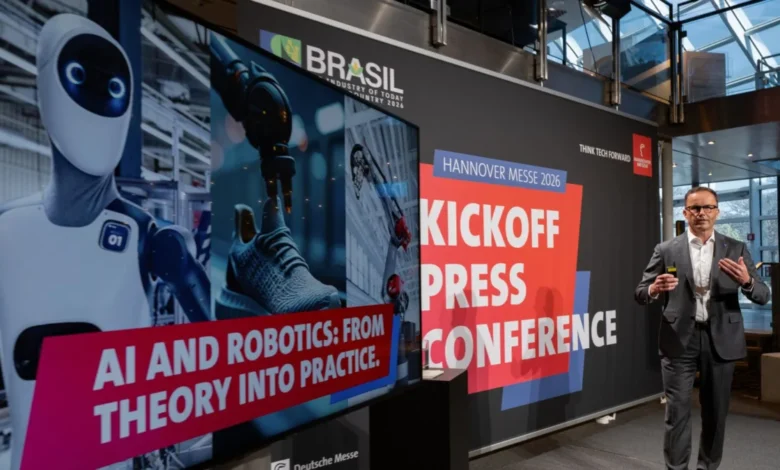
The Hannover Messe, the world’s leading trade fair for industrial technology, is set to convene from April 20 to 24, 2026, in Hannover, Germany. Annually attracting over 120,000 visitors from more than 150 countries, this upcoming edition designates Brazil as its official partner country, with a profound emphasis placed on the transformative potential of ‘Industrial AI.’ This central theme underscores the event’s commitment to showcasing artificial intelligence’s practical application and scalable integration within the manufacturing and industrial sectors.
A Global Nexus for Industrial Innovation
For decades, Hannover Messe has solidified its reputation as an indispensable meeting point for industry leaders, technology innovators, and policymakers worldwide. It serves as a crucial barometer for global industrial trends, bringing together cutting-edge advancements across high-tech, ICT, energy, and chemistry. The 2026 iteration continues this legacy, with over three thousand exhibitors expected to occupy thirteen halls, presenting their latest innovations and solutions. The focus remains steadfast on the applicability and scalability of new technologies, positioning Hannover as the epicenter for discussions on the future of production.
The exhibition’s historical trajectory reveals a consistent dedication to pushing the boundaries of industrial progress. From the early days of showcasing mechanical engineering prowess to embracing the digital revolution with themes like Industry 4.0 and integrated industry, Hannover Messe has consistently reflected and shaped the evolving landscape of global manufacturing. The pivot to ‘Industrial AI’ for 2026 is a natural progression, acknowledging the profound impact AI is already having and is projected to have on efficiency, productivity, and resilience across various industrial domains. This theme not only highlights technological breakthroughs but also addresses the strategic imperative for industries to adopt AI for sustained competitiveness in a rapidly changing global economy.
The Dawn of Industrial AI: Practical Applications in Manufacturing
The 2026 edition is meticulously curated to explore the practical deployment of artificial intelligence in the manufacturing industry. Exhibitors will demonstrate how AI, synergistically combined with robotics, automation, and digitalization, can yield measurable improvements in production processes. This goes beyond theoretical discussions, focusing on tangible case studies and live demonstrations of AI-driven solutions that enhance operational efficiency, reduce downtime, optimize resource allocation, and foster innovation.
During a recent press conference, Dr. Jochen Köckler, CEO of Deutsche Messe AG, highlighted several pioneering examples that exemplify the event’s core theme. One such innovation comes from Agile Robots, a company slated to showcase its humanoid robot, Agile ONE. This advanced robotic system is engineered to operate autonomously within complex industrial environments, performing tasks that traditionally required human intervention. The demonstration of Agile ONE is expected to draw significant attention, illustrating the advanced capabilities of next-generation robotics in handling intricate manipulations and adapting to dynamic factory floor conditions, thereby offering new avenues for productivity and safety.
Another compelling example cited by Köckler is from the German company Sew-Eurodrive. They will introduce an AI-based chat function designed to configure machines using natural language, critically, without relying on large language models (LLMs). This innovation aims to dramatically shorten commissioning times for industrial machinery. By enabling operators to interact with machines through intuitive conversational interfaces, Sew-Eurodrive addresses a long-standing challenge in industrial automation: the complexity and time-consuming nature of machine setup and parameterization. This approach promises to democratize access to advanced machine control, making sophisticated systems more user-friendly and adaptable. The emphasis on non-LLM solutions also highlights a trend towards specialized, efficient AI applications tailored for specific industrial tasks, minimizing computational overhead and ensuring robust performance in critical operational contexts.
Siemens, a perennial fixture at Hannover Messe and a global powerhouse in industrial technology, will also present a suite of AI-driven solutions. Among their key demonstrations will be a highly flexible production line for shoes, where robots transcend mere recommendations to autonomously execute actions. This setup integrates both autonomous packaging robots and humanoid robots, showcasing a sophisticated level of collaborative automation. The robots in this system are designed not just to assist but to actively participate in the manufacturing process, making real-time decisions and adapting to variations in production requirements. This level of autonomy represents a significant leap forward in manufacturing flexibility, enabling customized production at scale and responding rapidly to market demands. The integration of various robotic forms within a single production line illustrates the diverse roles AI-powered robots can play, from precision assembly to complex logistical operations.
Dr. Köckler further emphasized the increasing maturity of humanoid robotics, noting that approximately fifteen companies would exhibit humanoid robots at the fair. This surge in presence, he stated, "underscores that this technology is making the leap from research into industrial deployment." This transition signifies a critical inflection point, as humanoid robots move beyond experimental labs into practical, real-world applications on factory floors. Their ability to mimic human movements and operate in environments designed for humans makes them particularly versatile for tasks requiring dexterity, adaptability, and interaction with existing infrastructure.
Center Stage: High-Level Dialogue and Visionary Insights
A significant new addition to Hannover Messe 2026 is the "Center Stage," a dedicated central platform designed for high-level discourse. This forum will bring together influential leaders from industry, politics, and academia to engage in critical conversations about the future of production and technology. The caliber of speakers underscores the event’s role in shaping global industrial policy and technological trajectories.
The opening day will feature a marquee discussion involving German Chancellor Friedrich Merz, alongside top executives such as Roland Busch, CEO of Siemens; Christian Klein, CEO of SAP; and Tim Höttges, CEO of Deutsche Telekom. Their dialogue is expected to center on the strategic imperative of scaling AI within industrial processes. This discussion will likely address the challenges and opportunities associated with AI adoption, including investment requirements, regulatory frameworks, workforce transformation, and the ethical considerations of deploying advanced AI systems. The participation of leaders from diverse sectors – industrial automation, enterprise software, and telecommunications – highlights the pervasive nature of AI and the need for a holistic approach to its integration across the industrial value chain.
The following day will bring a unique cross-industry perspective, with Toto Wolff, Team Principal and CEO of the Mercedes-AMG Petronas Formula 1 Team, joining Oliver Steil, CEO of software company TeamViewer. They are slated to discuss innovations in Formula 1 and the invaluable lessons the broader industry can glean from this high-performance sector. Formula 1, renowned for its relentless pursuit of marginal gains through data analytics, simulation, and rapid prototyping, offers a compelling model for industrial optimization and innovation. Their discussion will likely delve into how F1’s approach to real-time data processing, predictive analytics, and agile development can be translated to manufacturing processes, supply chain management, and product development cycles.
The Center Stage program also includes a crucial discussion on the future of humanoid robotics, featuring representatives from leading technology and manufacturing firms such as Microsoft, Nvidia, Hexagon, Agile Robots, BMW, and Schaeffler. This panel will explore the technological advancements, economic implications, and societal impact of increasingly sophisticated humanoid robots. Topics are expected to range from the technical challenges of developing robust, intelligent humanoid systems to the potential for human-robot collaboration in various industrial settings, and the broader implications for future workforces.
Further underscoring the global significance of innovation and entrepreneurship, the event will feature a special video message from former U.S. President Barack Obama. In his address, Obama is expected to encourage aspiring entrepreneurs to "be courageous in shaping the future," emphasizing the critical role of innovation and bold leadership in navigating complex global challenges and seizing new opportunities. His message serves as a powerful call to action for the next generation of industrial pioneers.
Geopolitics, Defense, and Brazil’s Strategic Role
Beyond technological advancements, Hannover Messe 2026 will also address broader themes of geopolitical dynamics, the defense industry, and global energy demand. These discussions reflect the complex interplay between technology, security, and international relations in the contemporary world.
A new thematic area, the "Defense Production Park," will host approximately forty companies demonstrating how production technology can be scaled for security-critical applications. This initiative is particularly timely given evolving geopolitical landscapes and increasing global defense spending. The park will showcase innovations in advanced manufacturing, materials science, automation, and supply chain resilience that are vital for strengthening national defense capabilities. This segment highlights the dual-use nature of many industrial technologies and the growing convergence of commercial and defense sector innovations. Discussions within this area are expected to cover topics such as secure supply chains, rapid prototyping for defense applications, and the ethical considerations of AI in defense.
Parallel to these specialized discussions, broader conversations are planned on the impacts of automation, the cultivation of innovation ecosystems, and the anticipated changes in the labor market driven by AI adoption. These sessions will offer platforms for policymakers, industry leaders, and academics to explore strategies for workforce retraining, talent development, and fostering environments conducive to sustained technological growth. The dialogue will also touch upon the societal implications of AI, including job displacement concerns, the need for new skills, and the imperative to ensure an equitable transition in the era of smart manufacturing.
Brazil’s designation as the partner country for Hannover Messe 2026 holds significant geopolitical and economic weight. The opening ceremony will be graced by the presence of both German Chancellor Merz and Brazilian President Luiz Inácio Lula da Silva, symbolizing the deepening ties between Europe’s economic powerhouse and South America’s largest economy. Deutsche Messe explicitly stated that "especially against the backdrop of the current geopolitical situation, Brazil – and thus South America as a whole – is gaining importance as a reliable trade and industrial partner for Germany and Europe."
This partnership reflects a strategic diversification of economic alliances, particularly in light of ongoing global supply chain disruptions and geopolitical realignments. Brazil offers a vast market, rich natural resources, a growing industrial base, and significant potential for investment in renewable energy and sustainable technologies. For Germany and Europe, strengthening ties with Brazil represents an opportunity to enhance resilience in global supply chains, secure access to critical raw materials, and foster new markets for advanced industrial technologies. The partnership is expected to facilitate bilateral trade, promote foreign direct investment, and encourage technological exchange, thereby reinforcing South America’s role in the global industrial landscape. Brazil’s participation will highlight its capabilities in areas like agribusiness, renewable energy, mining, and advanced manufacturing, showcasing opportunities for collaboration and investment.
Broader Implications and Outlook
The Hannover Messe 2026, with its central theme of ‘Industrial AI,’ stands as a pivotal event for understanding the future trajectory of global industry. The implications of widespread AI adoption in manufacturing are far-reaching, encompassing economic, social, and geopolitical dimensions.
Economically, Industrial AI promises unprecedented gains in productivity and efficiency. By optimizing production processes, enabling predictive maintenance, and facilitating mass customization, AI can significantly reduce operational costs and enhance competitiveness for businesses. Market research indicates that the global AI in manufacturing market is projected to grow substantially, with estimates often placing its value in the tens of billions of dollars by the end of the decade, driven by increasing automation and data utilization. This growth will spur innovation, create new business models, and attract significant investment into research and development.
Socially, the rise of Industrial AI will inevitably transform the workforce. While concerns about job displacement are valid, the focus at Hannover Messe will likely also be on job transformation and creation. AI is expected to automate routine and hazardous tasks, freeing human workers to focus on higher-value activities requiring creativity, critical thinking, and complex problem-solving. This necessitates massive investments in reskilling and upskilling programs to equip the current and future workforce with the necessary digital and AI literacy. The discussions on the Center Stage and within thematic areas will play a crucial role in shaping policy responses to these workforce challenges, aiming to ensure an inclusive transition.
Geopolitically, the race for AI dominance in industry is becoming a critical component of national economic and strategic competitiveness. Countries and economic blocs that successfully integrate AI into their industrial bases will gain a significant advantage in global trade and innovation. The emphasis on strengthening partnerships with countries like Brazil underscores a strategic shift towards diversifying technological and industrial alliances, fostering resilient global supply chains, and mitigating risks associated with over-reliance on single regions. The "Defense Production Park" further highlights the intertwining of industrial capability with national security, reflecting a broader global trend of industrial policy being increasingly influenced by strategic considerations.
As the world navigates a complex era of technological acceleration and geopolitical flux, Hannover Messe 2026 provides an essential platform for dialogue, demonstration, and decision-making. By bringing together the brightest minds and the most innovative technologies, it aims to not only showcase the future of industry but also to actively shape it, ensuring that the transformative power of Industrial AI is harnessed responsibly and effectively for global progress.
Related posts: