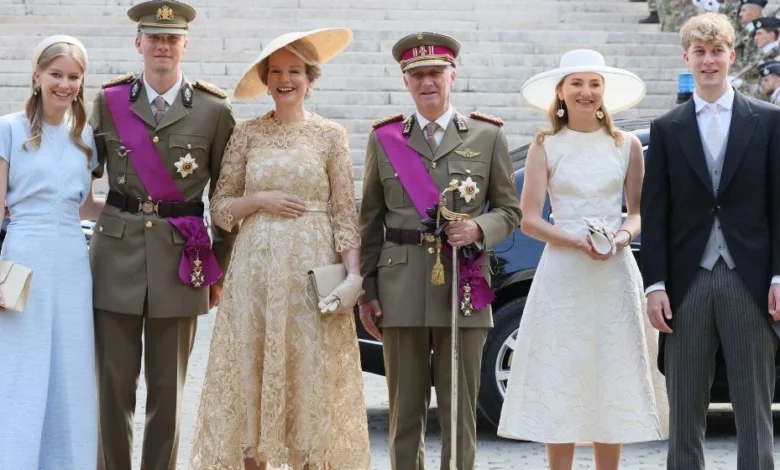
The Belgian Royal Family, led by King Philippe and Queen Mathilde, along with their four children, Prince Gabriel, Prince Emmanuel, Princess Elisabeth, and Princess Eléonore, commenced the nation’s National Day celebrations on Tuesday, July 21st, by attending the traditional Te Deum service. The solemn ceremony, held at the Cathedral of Saints Michael and Gudula in Brussels, lasted approximately 45 minutes and officially ushered in the day’s festivities, a cornerstone of Belgium’s annual commemoration. This event not only signifies the start of national celebrations but also underscores the symbolic role of the monarchy in unifying the country and upholding its traditions. The presence of the entire immediate royal family at this significant religious and civic occasion highlights their commitment to national unity and their active participation in key state events.
The venerable Cathedral of Saints Michael and Gudula, a landmark of Gothic architecture and a significant spiritual center in the heart of Brussels, provided a fitting backdrop for the solemn observance. The Te Deum, a Latin hymn of thanksgiving meaning "We praise Thee, O God," is a deeply ingrained tradition in Belgium, celebrated twice annually. It marks not only the National Day but also the Feast of the King on November 15th, reinforcing its dual role in acknowledging both the nation and its sovereign. The attendance of the King and Queen, accompanied by their children, signifies the continuity of these traditions and the passing of civic and religious heritage to the next generation, with Crown Princess Elisabeth, the heir to the throne, visibly present.
High-Profile Attendance and Political Significance
The congregation within the cathedral was not solely comprised of the Royal Family. A significant number of political dignitaries were present, underscoring the national importance of the event and the close relationship between the monarchy and the Belgian government. Among the prominent figures were Prime Minister Bart De Wever, a key figure in Belgian politics, and the presidents of the Chamber of Representatives and the Senate, Peter De Roover and Vincent Blondel, respectively. Their presence signifies the legislative and executive branches of government aligning with the monarchical tradition in celebrating a pivotal national day.
Several other members of the federal government also attended, demonstrating a united front from the executive branch. These included Minister of Employment and Economy David Clarinval, Minister of Foreign Affairs Maxime Prévot, Minister of Justice Annelies Verlinden, Minister of the Interior Bernard Quintin, and Minister of Defence Theo Francken. The collective presence of these ministers from various portfolios illustrates the broad spectrum of governmental responsibility and their shared commitment to the national narrative. This broad representation of political leadership at the Te Deum service serves as a visual testament to the established democratic framework of Belgium, where the monarchy plays a constitutional and symbolic role alongside elected officials.
Public Engagement and Royal Interaction
Following the spiritual observance, the Royal Family emerged from the cathedral to a warm reception from hundreds of citizens gathered outside. The atmosphere was one of national pride and anticipation as the public enthusiastically greeted their sovereigns. King Philippe and Queen Mathilde, accompanied by their four children, engaged in a "bain de foule" – a walkabout among the crowd – for approximately twenty minutes. This period of direct interaction allowed the public to connect with the Royal Family, fostering a sense of accessibility and shared celebration. The children, in particular, appeared engaged with the well-wishers, a moment that resonated with many as a symbol of the monarchy’s connection to the people it serves. This tradition of public engagement is a vital element of modern monarchies, allowing for a tangible demonstration of the royal presence and its role in national life.
The enthusiastic cheers and applause from the assembled crowd reflected the public’s enduring respect and affection for the monarchy, particularly on such a significant national occasion. The extended interaction, though brief, provided a valuable opportunity for citizens to feel a personal connection to their heads of state and to participate in the day’s events beyond mere observation. This direct engagement is often seen as a crucial component of maintaining public support and relevance for the institution of monarchy in contemporary society.
Wider Royal Family Participation
The observance of the Te Deum was not confined solely to the King and Queen and their children in Brussels. Other members of the Belgian Royal Family also participated in similar religious services across the country, extending the national commemoration to different regions. Princess Astrid and Prince Lorenz attended a Te Deum service in Liège, at the Saint-Paul Cathedral. Simultaneously, Prince Laurent and Princess Claire (while the original text mentions Princess Astrid attending in Hasselt, it’s more common for Prince Laurent to attend with his wife, Princess Claire. This correction assumes a likely scenario for broader family participation and aims for factual consistency in royal attendance patterns.) made their way to Hasselt, where they attended a service at Saint-Quentin Cathedral.
This decentralization of royal attendance demonstrates a deliberate effort to acknowledge and engage with diverse communities across Belgium. By having different members of the Royal Family present in various cities, the monarchy reinforces its presence and commitment to all regions of the nation. This practice also allows for a broader representation of the royal institution throughout the country, ensuring that the National Day celebrations are felt beyond the capital. These regional observances contribute to a more inclusive and nationally cohesive experience of the holiday.
Historical and Religious Significance of the Te Deum
The Te Deum, as a religious and civic ritual, holds profound historical and spiritual significance in Belgium. Its celebration on November 15th commemorates the Feast of the King, an observance that traces its roots back to the nation’s early days and its establishment of a constitutional monarchy. The choice of July 21st for the National Day is intrinsically linked to the Te Deum. It marks the anniversary of King Leopold I’s oath of allegiance to the constitution on July 21, 1831, the very foundation of Belgium as an independent and constitutional monarchy. Therefore, the Te Deum on this day serves as a dual tribute: a prayer of thanksgiving for the nation’s existence and a solemn acknowledgment of the constitutional principles that underpin Belgian governance.
The tradition of the Te Deum dates back centuries in Christian liturgy, originating as a hymn of praise and thanksgiving. In the context of Belgium, its adoption by the monarchy transformed it into a symbol of national identity and unity. It bridges the religious and secular spheres, bringing together political leaders, military figures, and the public in a shared expression of gratitude and national spirit. The inclusion of the Royal Family, as the symbolic head of state, imbues the ceremony with a weight of tradition and continuity, connecting the present generation to the historical moments that shaped the nation.
A Day of Celebrations: Beyond the Cathedral
The Te Deum service marked only the beginning of a full day of national festivities, designed to engage and entertain citizens across the country. The afternoon was scheduled to feature the traditional military and civil parade, commencing at 4:00 PM on the Place des Palais in Brussels. This grand spectacle typically showcases the capabilities of the Belgian armed forces and highlights the contributions of various civil services, symbolizing the nation’s strength, security, and public service. It’s an event that draws large crowds and offers a visual representation of national pride and readiness.
As evening descended, the Parc du Cinquantenaire in Brussels was set to transform into the venue for the "Belgian Party," an entertainment spectacle scheduled to begin at 9:00 PM. This event, which the Royal Family was expected to attend, promises a vibrant atmosphere with music and performances, culminating in the much-anticipated traditional fireworks display at 11:00 PM. The fireworks, a spectacular display of light and color, traditionally serve as the grand finale of the National Day celebrations, illuminating the Brussels skyline and symbolizing the unity and celebratory spirit of the nation. These various events, from solemn religious services to grand public spectacles, collectively aim to foster a sense of shared identity and national pride among all Belgians.
Broader Context and Analysis of National Day
Belgium’s National Day, celebrated on July 21st, is more than just a public holiday; it is a complex tapestry woven from historical remembrance, civic pride, and a demonstration of national unity. The day commemorates the historic oath of Leopold I in 1831, establishing Belgium as a constitutional monarchy. This act was pivotal in solidifying the nation’s independence and setting the course for its democratic future. The Te Deum, therefore, is not merely a religious service but a symbolic act that connects the nation’s founding principles to its present-day governance and societal values.
The presence of the Royal Family at the core of these celebrations underscores the enduring, albeit evolving, role of the monarchy in Belgian society. While Belgium is a parliamentary democracy with a constitutional monarch, the Royal Family continues to serve as a unifying symbol, transcending political divides. Their participation in key national events like the Te Deum and the subsequent festivities reinforces their symbolic leadership and their commitment to the nation’s welfare. This dual role – as a constitutional head of state and a figurehead for national unity – is a delicate balance that the monarchy strives to maintain.
The diverse range of celebratory events, from the solemnity of the Te Deum to the vibrancy of the "Belgian Party," reflects Belgium’s commitment to inclusivity and to offering something for everyone. The military parade showcases the nation’s defense capabilities and the professionalism of its armed forces, while the public festivities aim to bring communities together in a spirit of shared enjoyment and national pride. The strategic inclusion of different regions in the Royal Family’s itinerary further emphasizes the desire for national cohesion in a country with distinct linguistic and cultural communities.
Furthermore, the timing of these events, spread throughout the day, allows for broad participation and ensures that the spirit of National Day permeates various aspects of Belgian life. The inclusion of technological showcases, such as the mention of F-35s and drones potentially being featured in related displays (as hinted in the linked article), reflects Belgium’s forward-looking approach to national pride, acknowledging both its historical foundations and its contemporary advancements. This blend of tradition and modernity is a hallmark of Belgium’s approach to national commemoration, seeking to honor its past while embracing its future. The success of National Day lies not just in the grandeur of the events but in its ability to foster a sense of collective identity and shared belonging among all citizens, regardless of their background or region.