Théo Leoni’s Second Season at Reims Begins Amidst Adductor Pain, Sideline Ahead of Crucial Friendlies

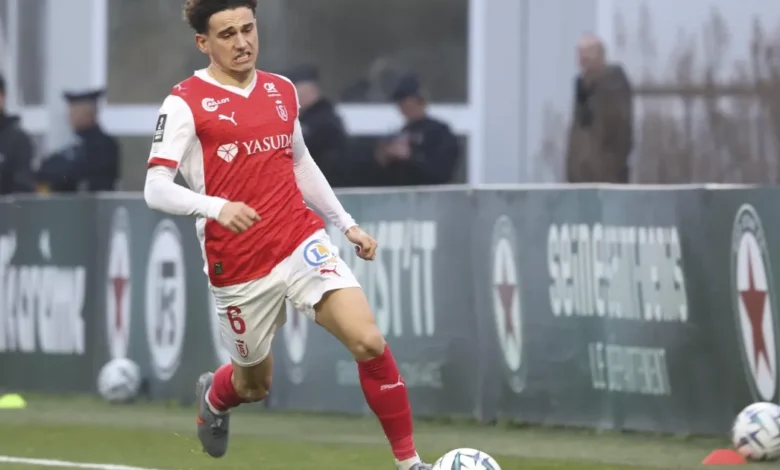
The Stade de Reims is gearing up for its second consecutive season in Ligue 2, a campaign that holds significant promise and pressure for the club as they aim to secure promotion back to the top flight of French football. Central to their ambitions is the experienced 26-year-old midfielder, Théo Leoni. However, as the team embarks on its pre-season preparations, a concerning adductor issue has cast a shadow over Leoni’s immediate availability, forcing him to miss several crucial friendly matches. This setback, while temporary, raises questions about his full integration into the squad under new head coach Nicolas Usaï and the team’s overall readiness for the demanding league schedule.
Leoni, a Belgian national, has already established himself as a vital component of the Reims squad. His presence is particularly significant this season, as the club has undergone a considerable rejuvenation, with a strong emphasis placed on developing younger talent. Having been part of the team that narrowly missed out on promotion to Ligue 1 under the previous management of Karel Geraerts, Leoni brings a wealth of experience and a proven track record in Ligue 2. The club’s hierarchy, including new sporting director, is reportedly placing considerable faith in his leadership and on-field contributions.
The early signs of Leoni’s importance under the new regime were evident in the initial pre-season fixtures. Nicolas Usaï, who took the helm of Stade de Reims this summer, quickly identified Leoni as a key figure, entrusting him with a captain’s armband in early preparatory matches. This leadership role was notably demonstrated during a recent 2-2 draw against Royal Charleroi, a fixture that showcased both the team’s potential and areas requiring further refinement. The shared points against a competitive opponent like Charleroi, who themselves are a well-established Belgian First Division A club, offered a glimpse into Usaï’s tactical approach and the team’s developing chemistry. However, Leoni’s subsequent absence from the field has disrupted this nascent cohesion.
Adductor Strain Sidelines Key Midfielder
The news of Leoni’s injury emerged from local reports, specifically from the newspaper L’Union, which closely follows the daily affairs of Stade de Reims. The publication detailed that Leoni is currently suffering from an adductor strain, a common yet often debilitating muscle injury in athletes. This ailment has directly led to his unavailability for the team’s training camp in Le Touquet and, crucially, for upcoming preparatory matches. His absence was keenly felt in the recent fixture against Paris FC, a match where his midfield presence and leadership were notably missed.
The club’s medical staff is diligently working to manage Leoni’s recovery, with the primary objective being to have him back to full fitness as swiftly as possible. While the exact timeline for his return remains uncertain, the club is cautiously optimistic. Head coach Nicolas Usaï has expressed his hope that Leoni could be available for the match against Kortrijk, a Belgian Pro League side, scheduled for August 1st. This fixture represents a significant test against a top-tier European opponent and would serve as a valuable benchmark for the team’s progress.
However, before the potential return against Kortrijk, Leoni will miss two other important pre-season encounters. The first is against Amiens, a familiar adversary in Ligue 2, and the second is against Cercle Brugge, another Belgian club that will provide a different stylistic challenge. These missed matches represent valuable opportunities for Leoni to fine-tune his understanding with his teammates, adapt to Usaï’s tactical instructions, and build match fitness. For a team undergoing a transition with new players and a new coach, these integrated sessions are paramount.
Strategic Implications for Reims’ Promotion Push
The timing of Leoni’s injury is particularly concerning given Stade de Reims’ overarching objective for the upcoming season: promotion to Ligue 1. The French football landscape is fiercely competitive, and the start of the league campaign often dictates the momentum for the entire season. The Ligue 2 season is scheduled to commence on August 8th, with Reims set to face Clermont. This opening fixture is a critical encounter, and the club’s aspirations to compete for the top positions hinge on having their key players available and in peak condition.
Leoni’s role within the midfield is multifaceted. Beyond his technical abilities and experience, he is expected to provide a stabilizing influence, particularly for the younger players being integrated into the first team. His leadership on the pitch can translate into improved team organization, better decision-making under pressure, and a more resilient defensive structure. The absence of such a pivotal player, even for a short period, can disrupt the team’s tactical fluidity and psychological resilience.
The club’s recruitment strategy this off-season has been geared towards building a squad capable of challenging for promotion. Reports indicate a significant investment in new talent, alongside the retention of experienced players like Leoni. This strategy underscores the ambition of the club’s ownership and management. However, the success of such a strategy is heavily reliant on the collective performance of the squad, which in turn depends on the availability and form of its key individuals.
Supporting Data and Context
To understand the significance of Leoni’s potential absence, it’s beneficial to consider the performance metrics of Stade de Reims in Ligue 2 during previous seasons. In the 2022-2023 season, Reims finished in 6th position, narrowly missing out on the promotion play-off spots. Their home form was generally strong, but inconsistencies on the road and a tendency to concede crucial goals in decisive moments were cited as contributing factors to their failure to secure promotion.
Leoni’s contribution in the previous season was noteworthy. While specific statistical data for his individual performances in Ligue 2 are not readily available in the provided text, his consistent presence in the squad and his role as a key player under Karel Geraerts suggest a significant impact on the team’s midfield control, ball retention, and defensive contributions. His ability to link play, break up opposition attacks, and provide a steady presence are all qualities that are indispensable for a team aiming for promotion.
The financial implications of promotion and relegation in French football are substantial. A return to Ligue 1 would not only elevate the club’s sporting prestige but also significantly increase its revenue through broadcasting rights, sponsorship deals, and increased matchday income. Conversely, another season in Ligue 2 could lead to financial stagnation and a potential loss of key talent if the promotion push falters. This financial imperative adds another layer of pressure to the current pre-season preparations and the team’s overall performance.
Broader Impact and Future Outlook
The adductor strain sustained by Théo Leoni is more than just a minor inconvenience; it represents a challenge that Stade de Reims must navigate strategically. The club’s ability to manage this situation effectively will be a testament to the depth of their squad and the coaching staff’s ability to adapt. The coming weeks will be crucial in determining whether Leoni can recover in time to regain match fitness before the league opener, and if not, how the team will compensate for his absence.
The integration of new signings and the adaptation to Nicolas Usaï’s tactical system are ongoing processes. Leoni’s injury could potentially slow down this integration, as he is a player who embodies the club’s experience and leadership. However, it also presents an opportunity for other players within the squad to step up, prove their worth, and gain valuable experience. This could foster a stronger sense of collective responsibility and depth within the team.
Looking ahead, Stade de Reims faces a demanding schedule. The club’s stated ambition to reach the top positions in Ligue 2 necessitates consistent performances and a robust squad. The early setbacks, whether due to injury or tactical adjustments, are an inevitable part of any football season. The resilience and adaptability demonstrated by the players and coaching staff in the coming weeks will be crucial in shaping the narrative of their promotion challenge. The focus for Reims now will be on ensuring Leoni’s full recovery, integrating him seamlessly back into the team, and ultimately, building a squad that is both talented and resilient enough to achieve their Ligue 1 aspirations. The adductor issue, while a temporary setback, serves as a stark reminder of the fine margins that often define success in professional football.