The Regionalized Framework of Driver Training
The most critical evolution in Belgian traffic law is the definitive regionalization of training and examination procedures. While the Royal Decree of March 23, 1998, remains the foundational federal law, the three regions—Flanders, Wallonia, and the Brussels-Capital Region—now exercise exclusive authority over the implementation of training cycles and examination criteria.
As of 2026, a strict regional adherence rule is in effect. Candidates are no longer permitted to "region-hop" during their learning process. This means a student who initiates their theoretical examination in Brussels is legally bound to complete their practical training and final examination within the Brussels-Capital Region. This measure was introduced to prevent "exam tourism," where candidates previously sought out regions perceived to have higher pass rates or more lenient testing environments.
Phase One: The Theoretical Examination
The journey toward a Category B license begins at the age of 17 with the theoretical examination. Across all three regions, the standards for success are harmonized: candidates must achieve a minimum score of 41 out of 50. However, the weighting of errors is severe. A "minor fault" results in a one-point deduction, whereas a "severe fault"—defined as any infraction of the third or fourth degree or a violation of speed limits—results in an immediate five-point deduction. Consequently, two severe faults lead to an automatic failure, regardless of other correct answers.
Language accessibility remains a regionalized matter. Examinations are conducted in the official language of the region: Dutch in Flanders, French in Wallonia, and either French or Dutch in Brussels. Given Belgium’s constitutional protections, examinations are also available in German within the German-speaking community. For non-native speakers, most regions offer the assistance of a sworn translator for an additional fee, typically ranging between €50 and €60. As of 2026, the base price for the theory exam is approximately €19 in Flanders and Brussels, and €17 in Wallonia, subject to annual indexation.
Phase Two: Practical Training and Provisional Licenses
Once the theoretical exam is passed, candidates enter the practical training phase, which is categorized into two main pathways: the "Free Track" (filière libre) and the "Driving School" (auto-école).
The Three Models of Provisional Licenses
Under the 2026 regulations, the "BelDrive" digital platform has become the mandatory portal for managing provisional licenses. There are three primary models:
- M18 (18-Month License): Available to candidates who have completed at least 20 hours of professional instruction at an accredited driving school. This license allows the candidate to drive alone, though they are prohibited from carrying passengers other than a qualified guide in certain circumstances.
- M36 (36-Month License): Designed for the "Free Track," this requires the candidate to be accompanied by a designated guide.
- M12 (12-Month License): A specific model for those whose previous provisional license has expired, requiring 6 hours of driving school instruction before the license is reissued.
The Role of the Guide
The legal requirements for guides have been significantly bolstered to improve the quality of informal training. A guide must have held a Belgian or European Category B license for at least eight years and must not have been subject to a driving ban within the last three years. In Flanders and Wallonia, guides are now required to undergo a mandatory "guide briefing" or pass a basic knowledge test before they can be officially registered on a candidate’s provisional license.
Regional Specifics: Roadbooks and First Aid
Regional divergence is most visible in the additional mandates required before a candidate can sit for the practical exam.
Wallonia and Brussels: Candidates opting for the free track must maintain a "Roadbook" or logbook. This document must prove that the candidate has completed at least 1,500 kilometers of driving under supervision. This measure was introduced to ensure that candidates do not rush to the practical exam without sufficient real-world experience.
Brussels-Capital Region: A unique requirement in Brussels is the mandatory First Aid training. Provided for free by the Belgian Red Cross, this involves a digital e-learning module followed by a three-hour in-person practical session. Candidates cannot obtain their final license in Brussels without this certification.
Flanders: The Flemish government has introduced the "Return Moment" (terugkommoment). For anyone domiciled in Flanders at the time of receiving their definitive license, a mandatory four-hour session must be attended between the sixth and ninth month of solo driving. This session, costing €122, focuses on road awareness and emergency maneuvers. Failure to attend results in criminal fines of up to €4,000.
The Practical Examination and Technical Proficiency
The practical exam can be taken from the age of 18, provided the mandatory minimum training period (usually three to nine months depending on the region) has been completed. The exam includes a "Hazard Perception Test," a computer-based evaluation of the candidate’s ability to identify dangerous situations in real-time.
As of 2026, the costs for the practical exam are approximately €42 in Wallonia, €46 in Brussels, and €51 in Flanders. If a candidate fails the practical exam twice, the law mandates 6 hours of professional instruction at an accredited driving school before a third attempt is permitted. Furthermore, candidates who pass their exam in an automatic vehicle will have "Code 78" applied to their license, legally restricting them from operating manual transmissions unless they pass a specific supplementary practical test.
Digital Transition and the 2033 Deadline
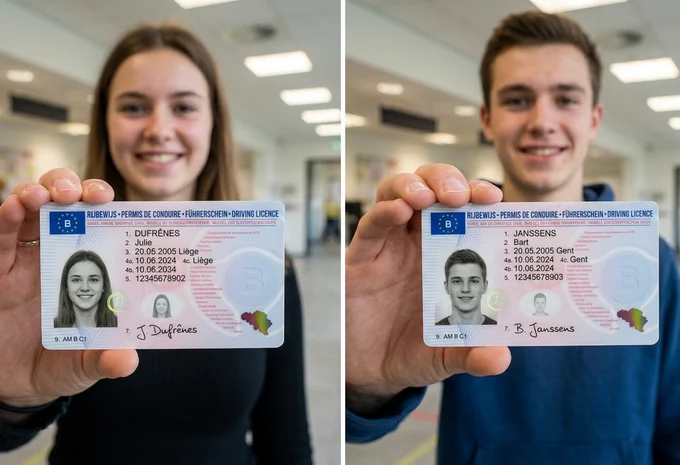
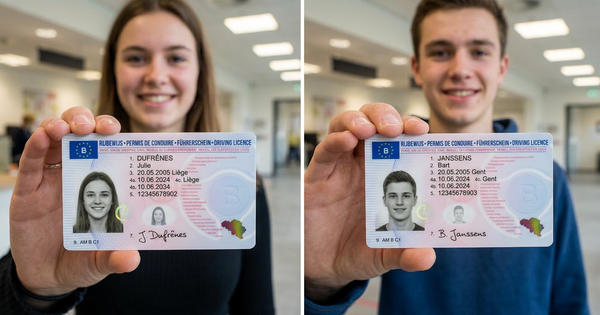
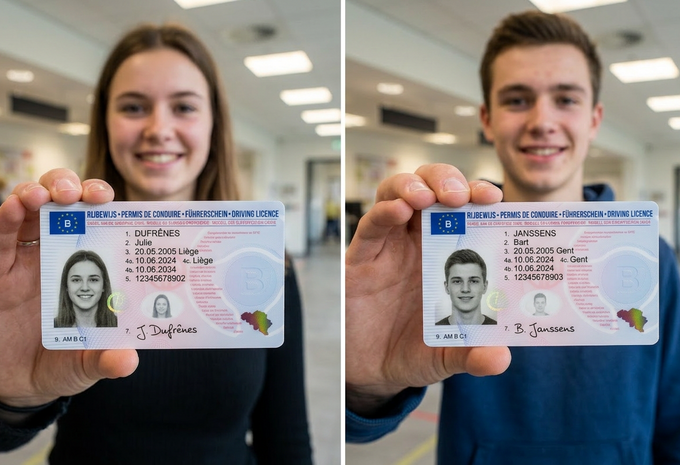
Belgium is currently in a transition period regarding the physical format of driving licenses. Following EU Directive 2006/126/EC, all traditional "pink paper" licenses must be phased out by 2033. Authorities strongly encourage drivers to exchange these for the plastic "credit card" format, which has a 10-year administrative validity.
A major milestone in 2026 is the full integration of the digital driving license via the MyGov.be application. Within Belgian territory, a digital license on a smartphone is legally sufficient for police checks. However, the federal government warns that this digital version is not yet recognized for international travel, where the physical card remains mandatory.
Specialized Categories and Modern Exemptions
The Category B license in Belgium has evolved to accommodate modern logistics and environmental goals.
- Electric Vehicles: To compensate for the heavy weight of battery packs, a Category B holder can operate electric goods vans with a Maximum Authorized Mass (MAM) of up to 4,250 kg, rather than the standard 3,500 kg, provided the vehicle is used for transport within the company.
- Mopeds and Motorcycles: A Category B license automatically includes Category AM (mopeds). For those who have held their B license for at least two years, a 125cc motorcycle (Category A1) can be operated within Belgium after four hours of training, with no exam required.
- Trailers: Category B allows for trailers up to 750 kg. For heavier trailers, the combined MAM of the vehicle and trailer must not exceed 3,500 kg. Exceeding this requires a "Code 96" or a full B+E license.
Enforcement, Penalties, and Reinstatement
Belgium continues to move toward a "Points License" system, although as of mid-2026, the executive orders for its full implementation are still being finalized. Currently, serious infractions are handled through a system of immediate license withdrawals and court-ordered bans.
For drivers who have had their license revoked by a police judge, reinstatement is often conditional. The judge may mandate four types of "reintegration exams": medical, psychological, theoretical, and practical. Only after passing these evaluations can the driver reclaim their right to operate a vehicle.
In the event of a lost or stolen license, the BelDrive platform allows for rapid duplication requests. If a license is lost abroad, Belgian embassies cannot issue a replacement; instead, the driver must obtain a local police report and apply for a new document upon returning to their municipality in Belgium.
Broader Implications and Analysis
The 2026 reforms represent a push toward "quality over quantity" in driver education. By mandating logbooks in the south and return moments in the north, Belgian regulators are attempting to curb the high accident rates among young drivers (aged 18-24), who remain statistically overrepresented in fatal road accidents.
The regionalization, while complex, allows regions to tailor road safety to their specific environments—addressing urban congestion and multimodal safety in Brussels versus high-speed rural road safety in Wallonia and Flanders. For the expatriate community and international residents, the system remains relatively accessible through reciprocal exchange agreements with many non-EU countries, provided the request is made within the first 185 days of Belgian residency.
Ultimately, the Belgian driving license is no longer a "lifetime" document but a dynamic permit that requires administrative renewal every decade and, in the near future, may be subject to the fluctuating tally of a points-based enforcement system. Drivers are urged to remain vigilant of their document’s expiration date and the specific regional mandates that apply to their place of residence.
Related posts: