Gladia: A French AI Transcription Powerhouse Excels in Major European Languages, Faces Hurdles with Dutch.

The tedious, time-consuming task of manually transcribing audio recordings is a familiar frustration for many professionals, particularly journalists, researchers, and legal practitioners. The advent of artificial intelligence-powered transcription tools has promised a revolution, offering significant time savings by converting spoken word into text with a mere click. Among the burgeoning landscape of such tools, Gladia, a French-based entity, is striving to distinguish itself through intelligent AI functionalities and a staunch commitment to European data sovereignty. However, recent evaluations reveal that while its performance in widely spoken languages like English is exemplary, its proficiency diminishes significantly when confronted with less-resourced languages, such as Dutch.
Gladia’s Market Position and Core Offering
Gladia, headquartered in Paris, has rapidly ascended to become a notable player in the global transcription market, boasting over 300,000 users. Its offering is compelling: a generous ten hours of free transcription services, followed by a competitive pricing model of €0.00017 per second. This "freemium" model allows potential users to thoroughly test the service without immediate financial commitment, a strategy that has proven effective in attracting a broad user base. The company positions itself as a versatile speech-to-text solution, capable of handling a variety of use cases beyond simple transcription, including real-time and asynchronous translation and integration into video conferencing platforms via its API.
The global market for speech-to-text technology is experiencing robust growth, driven by increasing demand across various sectors, including customer service, content creation, healthcare, and legal services. Projections indicate that the market could reach tens of billions of dollars in the coming years, underscoring the strategic importance of players like Gladia. Companies are vying for market share by offering enhanced accuracy, broader language support, and advanced features such as speaker diarization, sentiment analysis, and summarization. Gladia’s ambition to differentiate itself through "smart AI features" places it squarely within this competitive arena.
European Identity and Data Sovereignty: A Strategic Imperative
A cornerstone of Gladia’s market strategy is its explicit commitment to "100 percent data residency in Europe." This claim resonates strongly within the European Union, where data privacy regulations like the General Data Protection Regulation (GDPR) are among the strictest globally. For organizations operating within the EU, ensuring that sensitive data, such as interview transcripts or confidential meeting recordings, remains within European jurisdiction is not merely a preference but often a legal and ethical imperative. This stance helps mitigate concerns about data access by foreign governments or compliance with non-EU data protection frameworks.
The significance of this commitment was further underscored in June, when the French cloud provider OVHCloud announced its intention to acquire Gladia. This potential acquisition suggests a strong technological alignment between the two entities, with OVHCloud’s robust European cloud infrastructure providing a secure and compliant foundation for Gladia’s operations. Such strategic partnerships within the European tech ecosystem are crucial for fostering digital sovereignty and reducing reliance on non-European cloud services, a growing priority for EU policymakers and businesses alike. The move by OVHCloud, a major European player in its own right, signals confidence in Gladia’s technology and its adherence to European values concerning data protection and privacy.
The Technological Backbone: Solaria Models and OpenAI’s Whisper
Despite its strong European identity and data residency claims, Gladia’s technological foundation incorporates a blend of proprietary innovation and open-source contributions. The company has developed its own speech-to-text models, named Solaria-1 and Solaria-3. These models are, however, built upon Whisper, an open-source audio model developed by OpenAI. This hybrid approach represents a common strategy in the AI industry, leveraging the power and community support of widely adopted open-source frameworks while building specialized layers on top to enhance performance and tailor functionalities.
Whisper, known for its impressive accuracy and multilingual capabilities, provides a strong starting point for Gladia. Its open-source nature means that it benefits from continuous improvements and contributions from a global community of developers. For Gladia, integrating Whisper likely accelerated development and provided a robust baseline for language processing. However, this reliance on an OpenAI model represents the "only, albeit minimal, non-European trait" in Gladia’s otherwise European-centric profile. This choice highlights the global interconnectedness of AI research and development, where even companies emphasizing regional sovereignty often draw upon universally available foundational technologies. The challenge for Gladia, and similar European tech firms, lies in demonstrating how their proprietary enhancements and data handling practices differentiate them sufficiently within this global technological landscape.
Accuracy in Major Languages: The English Test Case
ITdaily’s review, which forms the basis of this analysis, involved testing Gladia with various audio inputs. The first significant test involved an English-language interview. English is frequently cited as the "easiest" language for training AI models due to the vast availability of diverse and high-quality datasets. Even though the interview speakers were not native English speakers, which can sometimes introduce accents or non-standard sentence constructions that challenge AI, Gladia’s performance was notably strong.
The transcription produced by Gladia was described as a "truthful and correct representation of the conversation." The accuracy extended to the absence of "gibberish or incomplete sentences," and crucially, "every word was also assigned to the correct speaker." This latter point, known as speaker diarization, is a critical feature for professional transcription, as it allows for clear attribution of dialogue in multi-speaker conversations. The only minor flaw observed was the occasional misidentification of a company name, providing "all possible spellings except the correct one." This is a common challenge for AI models, which often struggle with proper nouns, brand names, and highly specialized jargon not adequately represented in their training data. Users can export their transcripts in various formats, including plain text, JSON, SRT, and VTT, offering flexibility for different applications. This robust performance in English makes Gladia a highly attractive option for international organizations or individuals whose primary language of operation is English.

The Multilingual Hurdle: Gladia’s Struggle with Dutch
Gladia proudly supports over a hundred languages and is optimized for the most widely spoken languages in Europe, including English, French, German, Spanish, and Italian. However, the true test of a multilingual AI tool often lies in its performance with less-resourced or less "popular" languages. When an ITdaily reviewer subjected a Dutch-language recording to Gladia, the results presented a stark contrast to its English performance.
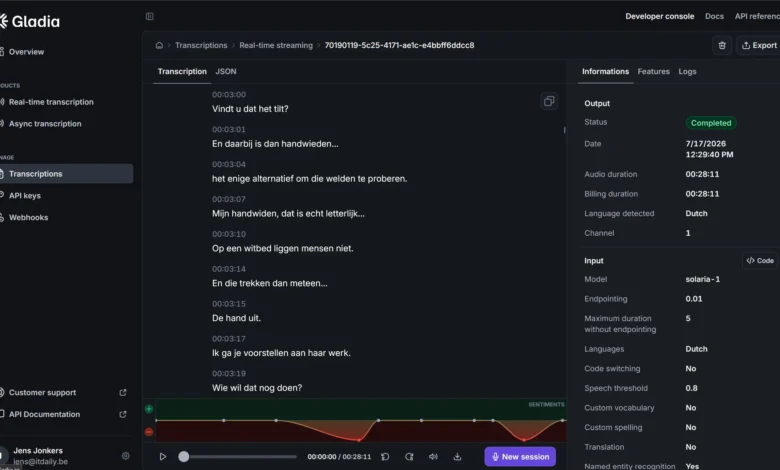
The transcription process for the Dutch recording was notably slower, and the initial output was "full of errors." While Gladia reportedly "recovered as more sentences were translated," the significant quality gap between a "popular" language like English and a "less popular" language like Dutch was undeniable. This observation highlights a common challenge in the field of multilingual AI: the availability and quality of training data. AI models thrive on large, diverse, and well-annotated datasets. Languages with fewer speakers or less digital content often suffer from a scarcity of such data, making it difficult to train models to the same level of proficiency as for languages like English. The phonetic complexities, unique grammatical structures, and nuanced vocabulary of languages like Dutch require extensive, specific training to achieve high accuracy. For businesses with a local footprint in Dutch-speaking regions, this limitation could be a significant barrier, necessitating critical evaluation of the output. This issue is not unique to Gladia; many AI transcription services exhibit varying degrees of accuracy across their supported languages, directly correlating with the volume and quality of available training data for each specific language.
Beyond Basic Transcription: Smart Features and Their Limitations
Gladia aims to be more than just a basic transcription service, integrating "smart AI functions" to provide added value. The company’s efforts in developing proprietary AI models like Solaria-1 and Solaria-3 suggest an ambition to move beyond mere "parrot work." These advanced features include translation services for transcripts and, notably, sentiment analysis.
Sentiment analysis attempts to determine the emotional tone or attitude expressed within a text or speech. This is a complex task for AI, as human sentiment is often conveyed through non-verbal cues, subtle inflections, pauses (such as "uhms," which Gladia does incorporate into transcripts), and context that can be difficult for algorithms to interpret. Gladia attempts to visualize the "atmosphere of the conversation" in a graph. While the review noted that "without context, this doesn’t say much," it inferred that a graph residing in the "green section" likely indicated a friendly and amicable conversation. However, the sentiment analysis for Dutch recordings was found to be highly erratic, "going in all directions," further reinforcing the conclusion that the reliability of Gladia’s advanced features, much like its basic transcription, is not uniform across all languages. This disparity underscores the fact that deep linguistic understanding is foundational for advanced AI features; if the core transcription is flawed, subsequent analyses built upon that text will inevitably suffer. The utility of such features, therefore, becomes directly proportional to the accuracy of the underlying speech-to-text conversion for the specific language in question.
API Integration and Use Cases
Gladia’s versatility is further enhanced by its API (Application Programming Interface), allowing developers to integrate its speech-to-text capabilities directly into other applications. This opens up a wide array of possibilities, such as adding real-time transcription and translation to video conferencing tools or incorporating it into customer service platforms for call analysis. The ability to perform both asynchronous and real-time processing caters to different operational needs, from transcribing pre-recorded meetings to providing live captions. However, the review noted that "correctly installing an API requires some technical expertise," implying that this advanced functionality is primarily targeted at developers and larger organizations with technical resources, rather than casual individual users relying solely on the web version. The strategic value of API integration for Gladia is immense, as it allows the company to extend its reach beyond its direct web interface, embedding its technology into a broader digital ecosystem and potentially powering numerous third-party applications.
Strategic Implications and Conclusion
Gladia presents itself as a robust and highly versatile transcription tool, offering capabilities that extend beyond simple speech-to-text conversion. Its generous free tier and transparent pricing structure make it an accessible option for individuals and businesses looking to experiment with AI transcription without immediate financial commitment.
The findings from ITdaily’s review suggest a clear dichotomy in Gladia’s performance. For organizations where English or French are the primary operational languages, Gladia is poised to deliver high-quality, accurate transcripts. Its commitment to European data residency further enhances its appeal for EU-based entities concerned with data privacy and compliance. This makes Gladia a strong contender in the European market for international and French-speaking businesses.
However, for users who primarily deal with Dutch-language interviews or customer interactions, a more critical assessment of Gladia’s output is necessary. The significant dip in quality for Dutch, encompassing slower processing and higher error rates, indicates that while Gladia supports many languages, it does not treat all of them with "equal love." This highlights a broader industry challenge: achieving universal high-accuracy across all languages remains a formidable task for AI developers. Companies operating in diverse linguistic environments, especially those relying on less-resourced languages, must carefully evaluate the performance of such tools against their specific needs and potentially consider language-specific solutions or supplementary human review.
Ultimately, Gladia’s trajectory will likely depend on its ability to enhance its multilingual capabilities, particularly for languages where it currently underperforms. The European tech ecosystem’s push for digital sovereignty and the increasing demand for localized AI solutions present both an opportunity and a challenge for Gladia. While its foundation is strong, addressing the linguistic disparities will be key to its sustained success and broader adoption across the diverse linguistic landscape of Europe. This ongoing evaluation by ITdaily, as part of its broader initiative to review European and open-source alternatives to popular American software tools, serves as a vital resource for businesses navigating the complex world of AI-powered solutions.
Related posts: